

Fiscal Sponsorship vs. 501(c)(3): Which Structure Fits Your Project?
For most founders launching a charitable initiative, the question isn't whether to operate as a nonprofit. It's how. The two most common pathways — fiscal sponsorship and incorporating an independent 501(c)(3) — lead to the same destination in different ways, on different timelines, and at different costs. Choosing between them is one of the most consequential structural decisions a project will make in its first year.
This guide compares the two side by side, so you can locate which path actually fits the work you're trying to do.
The Short Version
A 501(c)(3) is a fully independent tax-exempt nonprofit corporation, recognized by the IRS, with its own board, governance, and compliance obligations. A fiscal sponsorship is an arrangement in which an established 501(c)(3) extends its tax-exempt status to host your project under its umbrella, while you focus on programs and mission delivery.
The 501(c)(3) gives you institutional independence at the cost of significant time, money, and administrative overhead. The fiscal sponsorship gives you operational capacity immediately, at the cost of some shared governance and a sponsor relationship.
Neither is universally better. The right answer depends on what your project actually needs.
Speed to Launch
This is where the comparison is most stark.
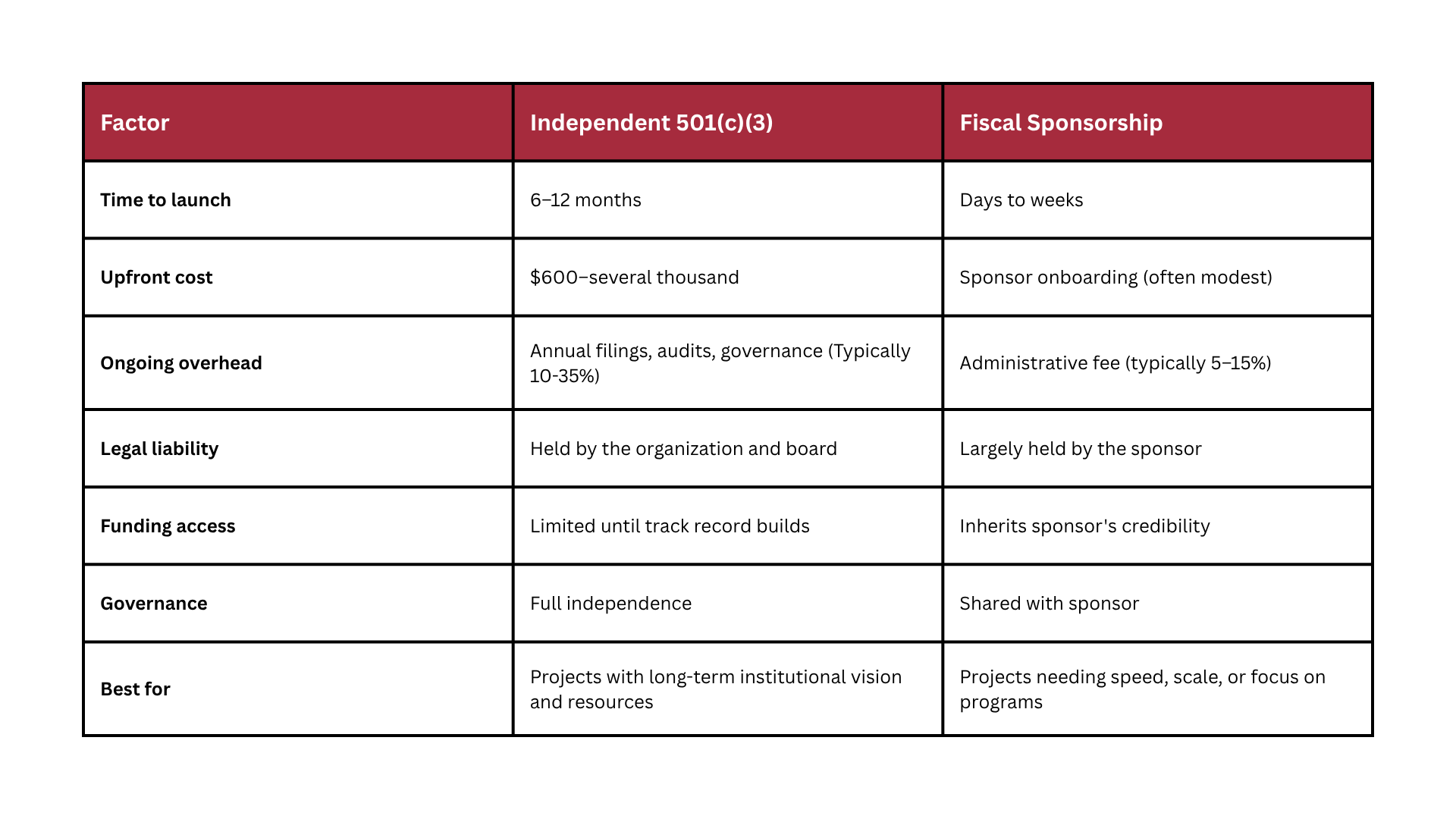
Securing 501(c)(3) status from the IRS typically takes between six and twelve months, sometimes longer when the government has a back-log. The process requires filing IRS Form 1023 (or the shorter 1023-EZ for smaller projects), drafting bylaws, forming a board, holding initial meetings, and waiting for the determination letter. During this period, the project cannot legally receive tax-deductible donations or apply to most foundations.
A fiscal sponsorship arrangement, by contrast, can typically be set up in days to a few weeks. Once the agreement is signed, the project is operating under the sponsor's existing 501(c)(3) status — accepting donations, applying for grants, and conducting programs immediately.
For projects with a grant deadline, a campaign window, or a community need that won't wait, this difference is decisive.
Cost and Administrative Burden
Independent incorporation comes with real expenses. Founders should expect to pay between $600 and several thousand dollars in filing fees, legal consultation, and incorporation costs in the first year. Annual compliance — Form 990 filings, state registrations, audits, board governance, payroll tax administration — adds ongoing overhead that many small projects struggle to carry. A 10k project can easily spend 50% of its budget on ovehead. A 100k project may spend 15-25%, and for a 1M project, 10-20% is more common.
Fiscal sponsorship typically charges an administrative fee between 5% and 15% of funds processed, with the exact rate depending on the sponsor and the level of service. In exchange, the sponsor handles compliance, tax filings, payroll, and the broader fiduciary infrastructure. For most projects under $500,000 in annual budget, the math favors sponsorship: the administrative fee is less than what an independent organization would spend building and maintaining its own back office.
The deeper cost calculation, though, isn't just dollars. It's attention. An independent 501(c)(3) requires founder time spent on governance, compliance, and administration. A fiscally sponsored project keeps that time on programs.
Legal and Fiduciary Responsibility
An independent 501(c)(3) carries its own legal liability. The board of directors holds fiduciary responsibility. The organization signs its own contracts, employs its own staff, and answers directly to regulators and donors.
Under fiscal sponsorship, depending on the model, the sponsor carries much of this weight. In a comprehensive (Model A) arrangement, the sponsor is the legal employer, holds all assets, covers the cost of insurance, creates compliance processes and assumes full fiduciary responsibility. In a pre-approved grant relationship (Model C), the project retains legal independence while the sponsor handles regranting and compliance for sponsored funds only.
For founders without nonprofit governance experience, the sponsor's legal infrastructure is often more than a convenience — it's the difference between operating safely and operating exposed.
Access to Funding
Both structures can receive tax-deductible donations and apply for foundation grants. But the practical access differs.
A new independent 501(c)(3), even after receiving its determination letter, faces a credibility threshold. Foundations frequently require multiple years of operating history, audited financials, and a track record before funding. New organizations spend their first one to three years building this institutional record while running on smaller individual donations.
A fiscally sponsored project applies for grants under the sponsor's track record, audit history, and institutional credibility. Major funders that would not consider a brand-new 501(c)(3) will often fund a sponsored project because the sponsor's infrastructure satisfies their due diligence requirements. For many emerging projects, this is the single most important strategic advantage of sponsorship.
Governance and Independence
This is where the trade-off cuts the other direction.
An independent 501(c)(3) has its own board of directors, sets its own policies, and operates with full institutional autonomy. The founder's decisions are constrained only by the board they have assembled.
A fiscally sponsored project operates within the sponsor's institutional framework. The sponsor exercises variance power over sponsored funds. Major decisions — large contracts, new programs, hiring — typically require sponsor coordination or approval. The project leadership has operational direction over its work, but it does not have the unilateral autonomy of an independent organization.
For founders who value full institutional control, this can feel constraining. For founders who recognize that infrastructure is heavy and would rather not carry all of it alone, this is exactly the point.
Long-Term Strategy
These are not permanent choices. Many of the most successful nonprofit organizations in the country began as fiscally sponsored projects and graduated to independent 501(c)(3) status once they reached the scale where independence made strategic sense.
A common pattern: a project begins under sponsorship to launch quickly, build a track record, and develop the operational maturity to carry independent infrastructure. Once the project has stable funding, experienced leadership, and clear long-term vision, it transitions out of sponsorship into its own 501(c)(3). The sponsor's job, done well, includes supporting that graduation.
The strategic question for most founders is not 'which one forever' but 'which one now.'
A Side-by-Side Summary
How to Decide
The choice between fiscal sponsorship and independent 501(c)(3) is rarely about which structure is 'real' or 'serious' — both are. It's about which structure matches your project's stage, scale, and strategic horizon.
-
If your project has 6-12 months before launch, and has institutional needs that no sponsor could meaningfully provide. Furthermore, if the founding team has nonprofit governance experience, and you have the time and resources to build infrastructure, acquire insurance, create contracts, etc. before launching programs.
-
If your project needs to move quickly, your founding team's strength is in mission delivery rather than administration, or you want to test and prove the work before committing to permanent institutional structure.
For many founders, the right answer is sponsorship first, independence later — letting the work build the case for its own infrastructure.
Holistic Underground
Holistic Underground has spent over a decade supporting mission-driven projects through both phases of this question. We've hosted more than fifty projects across four continents, and we've helped several of them graduate into their own independent 501(c)(3) status when the time was right. Our orientation is relational rather than transactional — we work with founders whose projects answer to a clear public good and whose work deserves serious institutional ground to stand on.
If you're weighing this decision for your own project, we'd welcome the conversation.