

Model A vs. Model C — Choosing Your Sponsorship Structure
Most fiscal sponsorship arrangements run on one of two models: Comprehensive (Model A) or Pre-Approved Grant Relationship (Model C). The difference between them is not cosmetic. It changes who employs your staff, who signs your contracts, who carries your tax liability, and how much of your back office you run yourself.
This page breaks down both models side by side, so you can see which one fits the way your project actually operates.
The Core Difference in One Sentence
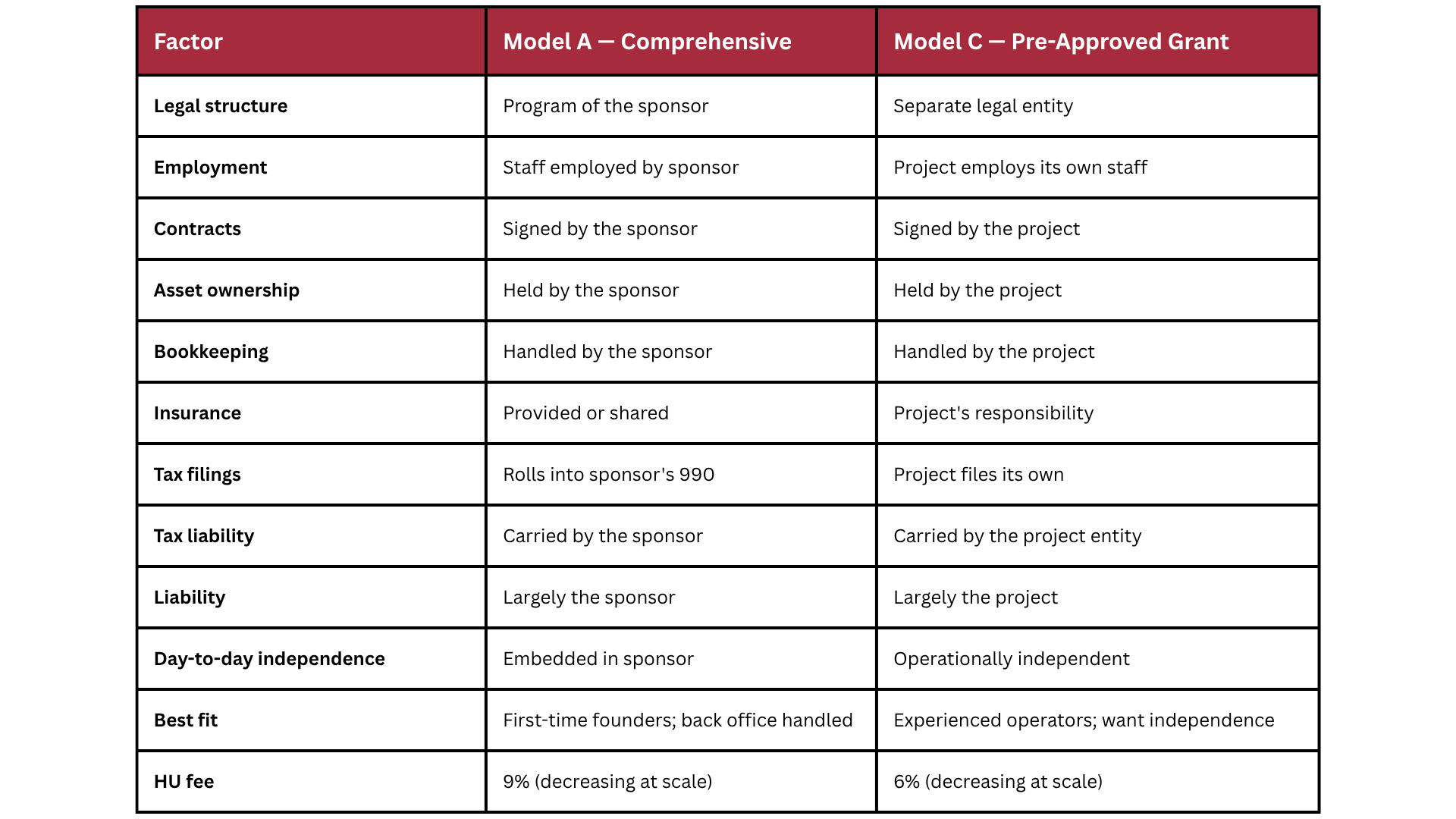
Under Model A, your project lives inside the sponsor as one of its programs. Under Model C, your project is its own legal entity, and the sponsor regrants funds to it.
Everything else — employment, liability, bookkeeping, taxes — flows from that single structural fact.
Model A — Comprehensive Sponsorship
Under Model A, the sponsored project operates as a program of the sponsoring 501(c)(3). There is one legal entity: the sponsor. Your project lives within it.
This means the sponsor is the legal employer of your staff, signs contracts on your project's behalf, holds your project's assets, and assumes full fiduciary responsibility for the work. Your project's funds sit in a restricted account within the sponsor's books. Your financial activity rolls up into the sponsor's annual Form 990. The sponsor covers insurance, runs payroll, handles HR, manages bookkeeping, and carries the compliance load.
From the outside, your project still looks like its own organization — its own name, brand, programs, and outcomes. From the inside, it's a program of the sponsor. This dual nature is the point: you get to present as an established nonprofit while the institutional weight stays with the institution.
In a healthy Model A arrangement, the sponsor genuinely handles the back office, and you feel freed to focus almost entirely on the mission. The administrative burden that would consume a meaningful share of a small organization's capacity — often 25% or more for an under-resourced team — moves off your plate.
Model A is the deeper model. It's the right fit for first-time founders, teams without nonprofit administrative experience, projects with insurance-sensitive work (children, elders, health, Page 3 Holistic Underground — Educational Pages 4–10 travel), and anyone who would rather not build a back office at all. Holistic Underground charges 9% under Model A, decreasing at higher revenue levels.
Model C — Pre-Approved Grant Relationship
Under Model C, the sponsored project is a separate legal entity — most often an LLC, an unincorporated association, or a state-formed nonprofit that hasn't yet received its own federal tax-exempt determination. There are two organizations: the sponsor and your project.
The sponsor's role is to receive tax-deductible donations and grants, take its administrative fee, and regrant the remaining funds to your project as restricted grants for charitable purposes. Your project handles its own employment, signs its own contracts, keeps its own books, files its own taxes, and carries its own liability.
The logic underneath Model C is straightforward: a funder has to give to a 501(c)(3), but the sponsor doesn't have to keep the funds. Each transfer from the sponsor to your project is its own transaction — usually a restricted grant, sometimes a reimbursement or contractor payment — with its own documentation.
In a healthy Model C arrangement, the sponsor provides the fiduciary oversight that makes the funding legitimate, processes the grants reliably, and offers guidance when you need it — without adding friction to the parts you'd rather run yourself.
Model C is the lighter model. It fits operationally sophisticated founders, projects that already have administrative infrastructure, and teams that want tax-exempt fundraising capability without institutional embedding. Holistic Underground charges 6% under Model C, decreasing at higher revenue levels.
A Side-by-Side Comparison
How to Tell Which One Fits
-
If yes, Model C is viable. If you'd rather not, Model A is the answer. Bookkeeping is the single biggest day-to-day difference between the two.
-
Founders with entrepreneurship or nonprofit-operations experience often prefer Model C's independence. First-time founders frequently find Model A's embedding is the support structure they didn't know they needed.
-
Programming with children, elders, medical services, or travel usually points to Model A, where the sponsor's institutional insurance can cover the work. Carrying that coverage as a standalone Model C entity is expensive and complex.
-
Under Model A, your project's activity flows through the sponsor — your project doesn't carry independent tax liability. Under Model C, your project is its own entity with its own tax treatment, which matters especially if you have any earned revenue. Before choosing Model C to save on the fee, a tax advisor should be engaged to determine whether the taxes owed on grants alone outweigh the roughly 3% difference between Model A and Model C.
-
If yes, Model C can be a natural intermediate step — you're already a separate entity, so the transition is structurally smaller.
A few plain-language diagnostics:
The Cost-Benefit Underneath the Choice
The headline fee isn't the whole picture. Model C's lower fee comes with operational costs you carry directly — your own bookkeeping, your own insurance, your own tax filing, your own legal. Model A's higher fee bundles those costs into one rate.
For many projects under roughly 500k, once you add up what Model C's “do-it-yourself” back office actually costs in dollars and founder hours, Model A's higher headline fee is often the more economical choice. For larger or more operationally mature projects, Model C's independence can become the better trade.
The right question isn't “which fee is lower.” It's “which total cost — in dollars, hours, and risk — fits my project.”
A Note on the Other Models
You may see references to Models B, D, E, and F. They exist but are rare. Most sponsors offer A and C because those two cover the vast majority of real-world needs. If a sponsor offers you something other than A or C, ask them to explain clearly why it serves your project better.
Holistic Underground
Holistic Underground offers both Model A and Model C, and we recommend a model as part of our intake process — weighing your bookkeeping capacity, your team's experience, your insurance profile, and your growth trajectory. Sometimes the right answer surprises the founder. We work most closely with mission-rooted projects — coalitions, NGOs, spiritual entrepreneurs, Page 5 Holistic Underground — Educational Pages 4–10 arts and culture initiatives, health equity and community empowerment work — whose founders want a sponsor that's genuinely present, not transactional.
If you're trying to decide which model fits your project, we'd welcome the conversation.